This exquisite circular painting showcases a vibrant lotus flower, gracefully dividing the composition into two distinct planes. On the right side, the divine Krishna captivates our gaze as he skillfully plays the flute, surrounded by a gentle herd of cows. In contrast, the other side portrays a gathering of mesmerized gopis, enchanted by Krishna's enchanting melodies. Notably, Krishna is adorned with intricate ornaments, embodying his regal form as the king of Dwaraka, rather than the traditional cowherd Krishna depicted with a turban. The painting captivates with its bold and harmonious color palette, skillfully combining bright, contrasting hues that enhance the overall visual impact.
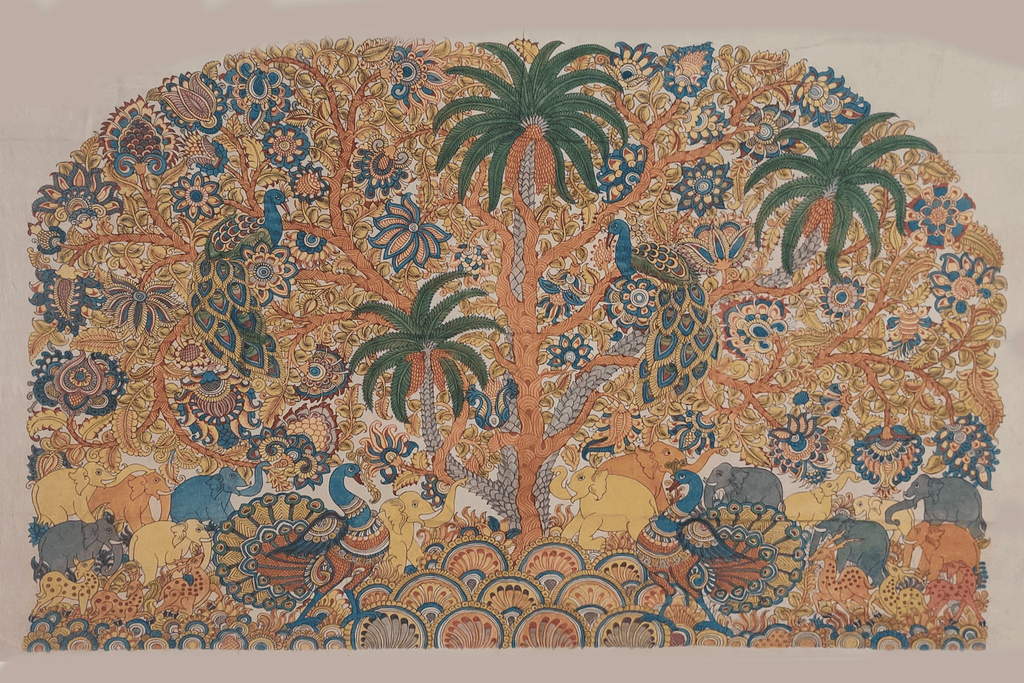
As a historical context, the Kalamkari art form, formerly known as Pattachitra, has been cherished across generations. Its roots can be traced to neighboring regions such as Odisha, as well as other parts of India and Nepal. The term "Pattachitra" derives from "patta," meaning "cloth," and "chitra," meaning "picture," reflecting the art's origin on fabric and fabric scrolls. Notably, references to such paintings are found in ancient Hindu, Buddhist, and Jain literature. During the medieval Islamic rule, the term Kalamkari emerged, combining "kalam," representing "pen" in Telugu, and "kari," signifying craftsmanship. It gained popularity under the patronage of the Golconda sultanate.
It's worth mentioning that this particular painting has been lovingly created on a made-to-order basis, ensuring its unique and personalized nature. Every stroke and detail of this artwork reflects the artist's skillful craftsmanship and commitment to capturing the divine essence of Lord Krishna's musical enchantment.
This is a Kalamkari-inspired painting done on canvas using acrylic paints. Unlike the traditional practice where natural dyes are meticulously applied on cloth, this painting employs modern materials while retaining the essence of Kalamkari's narrative and ornamental tradition.


 Ships worldwide

 ODOP Spotlight
 GI Tag


 Wishlist