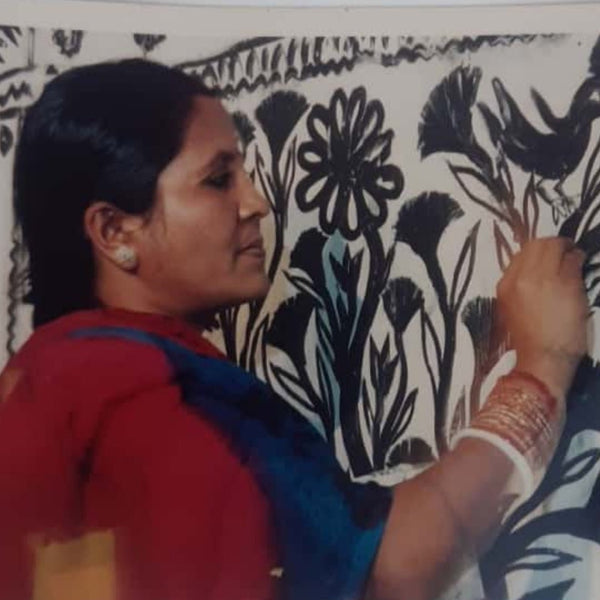
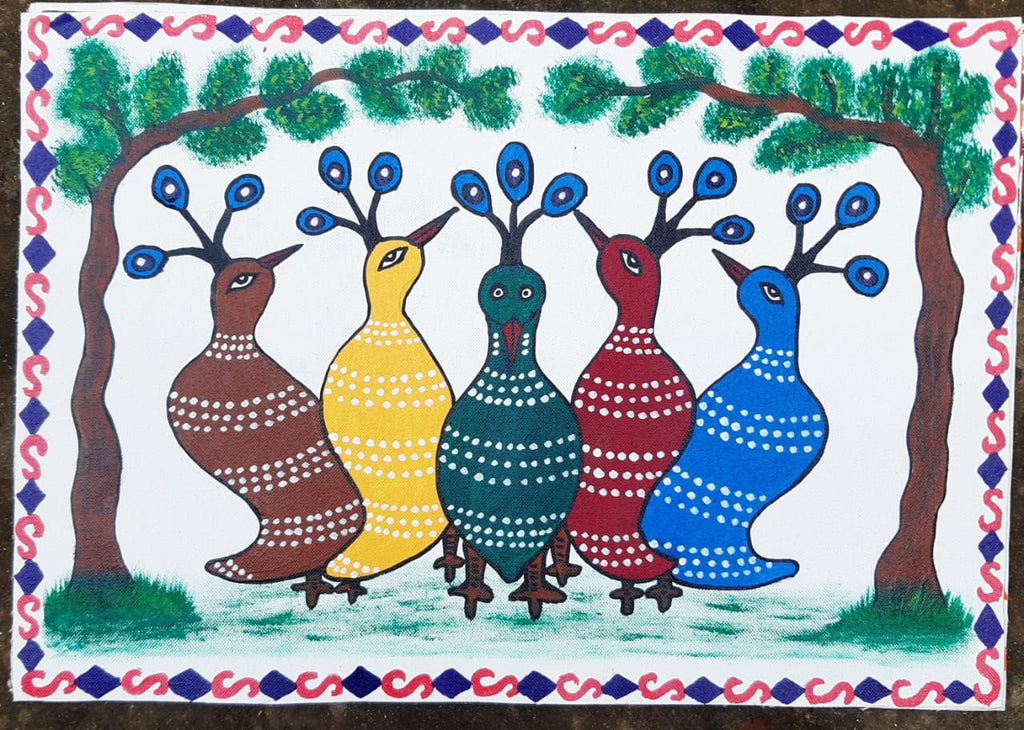
This dynamic Sohrai painting by Rukmani Devi beautifully depicts a pair of festive peacocks facing one another in a ritualistic dance of courtship or greeting. Sohrai is a traditional, indigenous art form native to the tribal communities of the Hazaribagh region in Jharkhand, historically painted by women on the clay walls of their homes to celebrate the harvest festival and honor the spirits of nature. Within this tribal ethos, wildlife is not merely observed but deeply integrated into the cultural narrative, with the peacock acting as a potent symbol of natural abundance, the arrival of the life-giving monsoons, and fertility. By portraying these birds in an intimate, face-to-face stance, the artist channels an ancient legacy of wall painting that transforms the everyday wilderness into a sacred visual celebration.
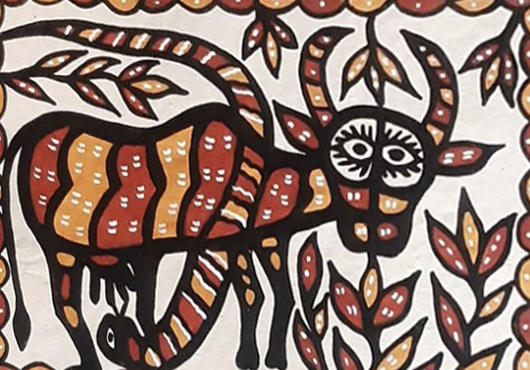
The composition is defined by its strong graphic quality, utilizing bold charcoal-black outlines and a traditional palette of earthy mineral colors such as ochre-yellow, rust-red, and natural white. The two peacocks occupy the center of the canvas, their long, slender legs and gracefully curved necks rendered in solid black silhouette. Their round bodies and fanned-out tails are filled with alternating vertical bands of red and yellow, heavily embellished with rows of delicate white dashed marks that mimic the texture of feathers. The bird on the left features distinct, vertical plumes rising from its back, while both creatures sport elaborate, crown-like crests on their heads. They lean in close, their pointed beaks almost touching, as a shower of fine black dashes floats in the air between them, dynamically capturing a moment of vocalization or energetic interaction.
The ground beneath the avian pair is rooted in a minimalist yet highly symbolic wilderness, decorated with stylized tribal flora. A central plant with pointed, tricolored leaves sprouts between the two birds, flanked by smaller, simpler floral buds in the lower corners that anchor the figures within a fertile landscape. The flat, pattern-heavy treatment of the subject matter strips away realistic perspective, focusing instead on the rhythmic balance and powerful primal energy inherent to traditional Sohrai folk designs.
The entire scene is beautifully enclosed within a sharp, geometric border that perfectly mimics traditional mud-wall relief framing. This border is composed of a continuous band of interlocking triangles rendered in alternating shades of deep rust-red and ochre-yellow, each containing a single white dot at its center. This striking, jagged outline tightly frames the high-contrast interior, providing a cohesive and authentic finish that honors the ancient, architecture-based origins of the artist's style.




 Ships worldwide