What is Warli Painting?
Warli painting is a tribal art created by the Warli community in the North Sahyadri Range of Maharashtra. Considered one of the finest examples of folk painting, Warli Painting is believed to have originated in the 10th century CE, although it gained widespread recognition only in the 1970s.
Traditionally, Warli artists use the mud walls of their clay huts as canvases, similar to how ancient peoples used cave walls for their artwork. This practice connects the artists to their cultural heritage and highlights their strong relationship with nature and their surroundings.
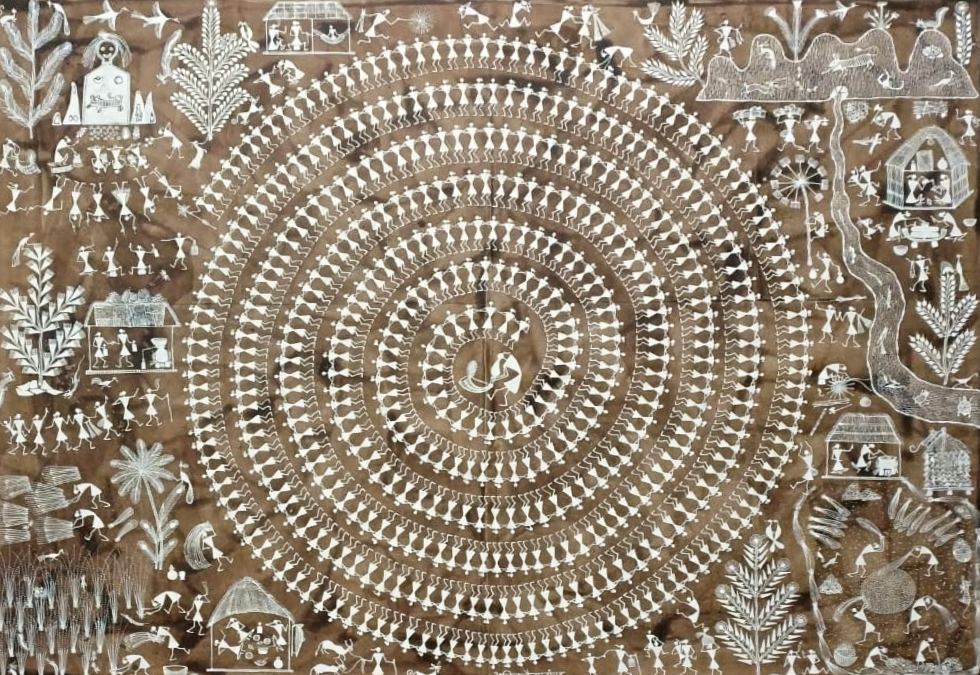
It uses geometric shapes to depict daily life, rituals and nature, made with rice paste. The art reflects strong cultural ties, spiritual beliefs, and reverence for nature. Common motifs include deities like Palaghat Devi, Panch Siriya and Bagh Dev, as well as animals, vegetation and the iconic Tarpa dance.
The Warli tribe, once semi-nomadic, now predominantly practices agriculture. Their art preserves tribal identity, fosters community bonding and has gained global recognition for its cultural significance.
Key Features of Warli Painting
Warli art is distinct due to its simplicity, symbolism and deep connection to the everyday life of the Warli tribe. It is built on a minimalistic visual language using basic geometric forms, natural pigments and rhythmic compositions. Each element within the artwork carries cultural and spiritual meaning, reflecting themes of nature, fertility, community and the cycle of life. Understanding its key features allows us to appreciate how this tribal art form embodies a rich philosophical and social worldview. They are:
- Geometric forms
- Human figures
- Monochromatic style
- Themes from daily life
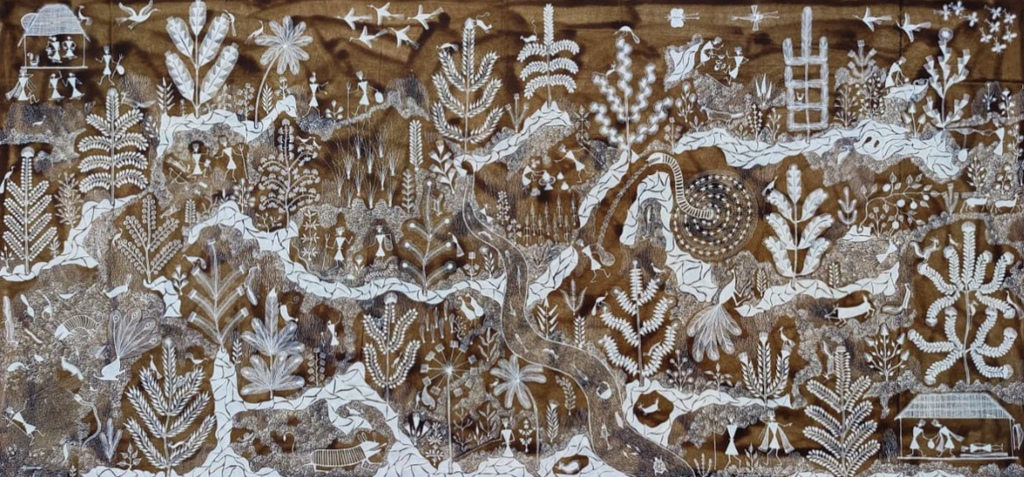
- Nature-centric motifs
- Ritualistic and religious significance
- Dynamic compositions
- Community expression
- Minimalism with symbolism
Warli art holds immense cultural and historical significance as one of India’s oldest living tribal art traditions. It serves as a valuable record of indigenous life, preserving the customs, rituals and beliefs of the Warli community across generations. Its emphasis on harmony between humans and nature highlights an ecological consciousness that remains relevant today.
History of Warli Painting
Origin of Warli Painting
The roots of Warli painting run incredibly deep, with its origin spanning thousands of years. It is a vital artistic expression that is considered to have evolved from prehistoric rock shelters into a sacred ritual art form rooted in the forests of western India.
Long before it was practiced on paper or textiles, this art form served as an unwritten script for the Warli tribe. As the Warlis did not historically have a written language, these simple drawings became their primary way of recording history and celebrating seasonal cycles, consequently passing down cultural knowledge through generations.
Archaeologists have found striking visual similarities between modern Warli paintings and prehistoric rock shelters dating as far back as more than 10000 years. For millennia, this art remained entirely secluded within tribal communities, passed down quietly as a localized folk tradition untouched by mainstream Indian art.
Evolution of Warli Painting
For most of its history, Warli painting was neither a commodity, nor a hobby or simple decoration. It underwent its first major evolutionary shift through its integration into the tribe's marriage rituals. The art form was traditionally practiced exclusively by married women, known as Savasinis, who painted the interior mud walls of a bride’s hut to bless the nuptials.
The artwork revolved around a sacred square called the Chauk. Inside this enclosure, the women would paint Palaghata, the goddess of fertility, who was believed to protect the couple and ensure the continuity of the tribe. Outside the square, they painted scenes of village life, from hunting to harvesting, using just two triangles joined at the tips to represent human bodies.
Unlike many other Indian folk arts, Warli painting never received the grand patronage of wealthy royal courts, Maharajas or Islamic Sultanates. Instead, its evolution stayed close to the earth.
The Warlis relied heavily on the forest for survival, and did not worship classical mythological deities. Instead, their art evolved into a profound tribute to the spirits of nature such as the sun, the moon, the mountains and the animals.
The biggest transformation in the history of the art form occurred in the 1970s, largely sparked by a visionary artist named Jivya Soma Mashe. He broke with centuries of tradition by becoming the first man to officially practice the art full-time. Mashe realized that the beautiful geometric language didn't have to be limited to ritual wedding walls, that it could be a powerful medium for artistic expression.
Mashe began painting on paper and canvas, taking Warli art out of the hidden tribal villages of Maharashtra and introducing it to large national platforms, as well as international art galleries in Paris, London and New York. This shift transformed the art form from its seasonal, ritual roots into a year-round creative profession.
Contemporary Warli Painting
In contemporary times, Warli art has expanded far beyond its traditional ritualistic and domestic settings, finding a place in diverse modern applications. It is recognized globally and has been granted a Geographical Indication (GI) status to protect its authentic heritage. Modern artisans and designers have translated these ancient stick figures onto global canvases.
In the world of fashion and textiles, Warli motifs are seen adorning silk sarees, block-printed tunics, dupattas and modern scarves, blending tribal aesthetics with contemporary design sensibilities. In interior decor, the art has gained popularity on minimalist ceramic pottery, designer lampshades, wall panels and large-scale public murals in major urban spaces, bringing its simplicity into modern living environments.
At the same time, contemporary Warli artists have adapted its traditional visual language to address modern themes. While older paintings focused primarily on village life, farming and rituals, newer works depict technology, urban transport, social change and environmental conservation.
Through this leap from the village mud wall to the global art gallery, Warli painting has managed to preserve its minimalist, traditional charm while successfully adapting to the sleek aesthetic of the modern world.
Warli Paintings Themes and Motifs
Traditional Warli painting operates like a visual language. As the community did not rely on written text, they developed an intricate vocabulary of geometric symbols, figures and layouts to document their worldview. Every line, circle and triangle tells a story of survival and interconnectedness.
Core Geometric Motifs
The entire universe of Warli art is constructed from just three elementary shapes found in nature. Rather than attempting a realistic representation of the world, the Warlis abstract reality into these fundamental forms.
- The Circle: This motif represents the two most powerful elements in the Warli sky, the sun and the moon. It symbolizes the passage of time, the changing of seasons, and the cyclical nature of life.
- The Triangle: Inspired by the natural topography of their homeland, the triangle represents mountains, conical hills and the sharp peaks of trees.
- The Square (Chauk or Chaukat): Unlike the circle and triangle, the square does not exist in nature, it is a human construct. It signifies a sacred enclosure and the safe sanctuary of a home.
- To create human and animal figures, artists join two triangles at their points, an inverted triangle for the upper torso and an upright triangle for the lower body. This clever design aligns with the human center of gravity, allowing the simple stick figures to convey energy and balance.
The Sacred Wedding Ritual (Lagna Chauk) and Palaghata
The most common traditional theme of Warli art is the wedding, specifically the painting of the Lagna Chauk. This central motif features a large, highly decorative square filled with intricate geometric patterns. Inside this protective square stands Palaghata, the goddess of trees and plants, who symbolizes fertility and childbirth.
The Warlis believe that a marriage ceremony is incomplete without this painting on the wall. Surrounding the square, artists paint the daily preparations of the wedding, including musicians playing instruments, women carrying pots of liquor and villagers arriving with gifts.
The Dev Chauk and Panchsiriya
Painted strictly right next to the Lagna Chauk, this enclosure houses male protective spirits rather than a goddess. Inside, artists paint Panchsiriya (the five-headed god), or a headless guardian warrior, often shown riding a horse. The sole purpose of this motif is to guard the venue, protecting the bride and groom from disease, witchcraft and misfortune.
The Tarpa Dance
The Tarpa is a long, horn-like musical instrument made from a dried gourd and bamboo.
In this motif, the Tarpa player stands in the absolute center of the canvas. Dozens of villagers, men and women alternating, interlock their hands and form a swirling spiral around the musician. The dancers move in unison to the music, mimicking the movement of a snake. This grand spiral represents the collective unity of the tribe and serves as a visual metaphor for the endless wheel of life.
Agricultural and Seasonal Cycles
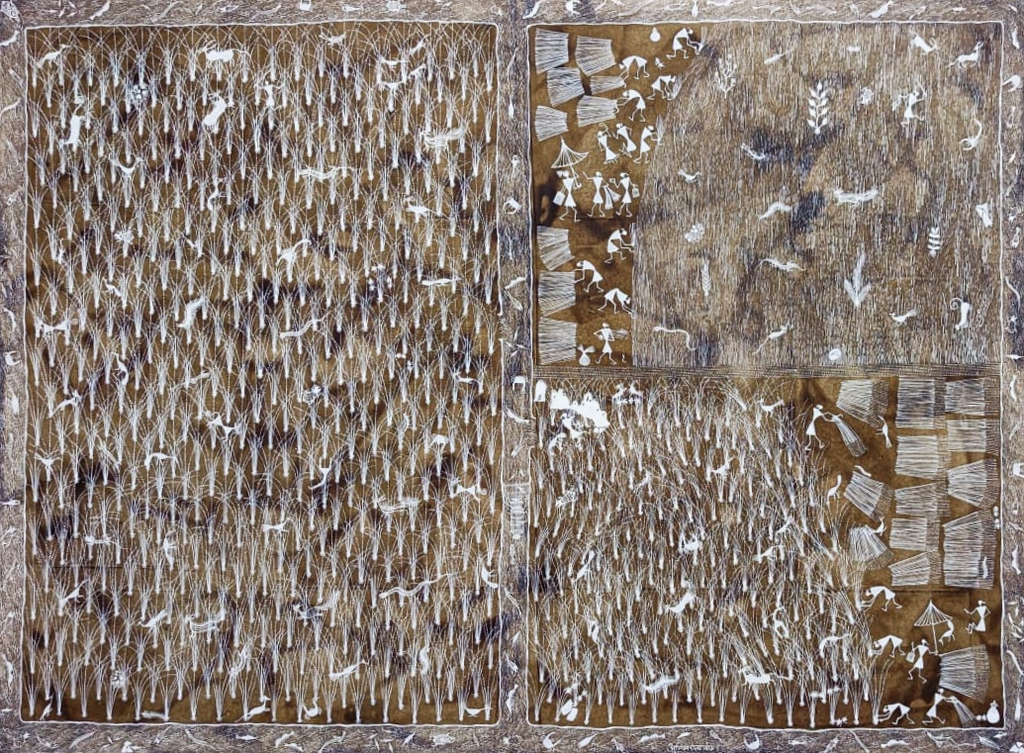
As an agrarian tribe completely dependent on the earth, the Warlis dedicate massive portions of their canvas to the cycles of farming. Common motifs include:
-
Sowing and Harvesting: Continuous rows of figures bending over fields to plant rice seedlings, cutting grain with sickles and carrying heavy bundles of hay on their heads.
-
Threshing and Storing: Villagers working around cattle to separate grain from chaff and filling large woven bamboo baskets (Kanghas) to store the harvest for winter.
Domestic Life and the Village Eco-System
Beyond rituals and farming, Warli paintings capture the quiet beauty of everyday life. The canvas acts as a panoramic snapshot of a bustling village. Artists meticulously dot the background with intimate domestic scenes such as:
- Women grinding grain with a heavy mortar and pestle, fetching water from local streams in stacked clay pots.
- Men climbing tall palm trees to extract Tadi (toddy/palm wine), setting out into rivers with woven fishing nets.
- Children playing traditional games, swinging from tree branches, chasing farm animals.
Flora and Fauna
The Warli people see themselves as equals to the wildlife around them, not masters over it. Animals are painted with the same dignity and two-triangle anatomy as humans.
-
The Tree of Life: A sprawling central tree motif, meticulously filled with tiny leaves, birds, monkeys and squirrels, symbolizing shelter and life itself.
-
Sacred Animals: Domestic helpers like bullocks pulling wooden plows, faithful watchdogs guarding huts and majestic tigers, who are revered as protectors of the forest rather than feared as predators.
Materials Used in Warli Paintings
Natural Pigments Used in Warli Paintings
One of the most defining characteristics of Warli painting is its absolute minimalism and eco-friendly nature. Unlike other Indian folk arts that utilize a vast spectrum of vibrant colors, traditional Warli art relies entirely on a monochromatic palette, using just a single color against a textured, earthy background.
Every substance used to create a Warli painting is sourced directly from the local forest and village environment. This reliance on raw, organic materials reflects the sustainable philosophy of the Warli tribe, who view their art not as a luxury trade item, but as a spiritual offering to nature that gracefully ages and returns to the earth over time.
Colors Used in Warli Paintings
-
White: White is the primary color of Warli art, used to draw every single stick figure, animal and geometric pattern. It is obtained by grinding rice into a fine powder, which is then mixed with water to create a smooth, liquid paste. To ensure the white paint adheres firmly to the wall and doesn't flake off when dry, artists mix in a small amount of natural gum extracted from local acacia trees.
-
Red-Brown Ochre: The warm, rustic background that gives Warli art its iconic contrast is not painted on is the literal surface of the wall. The village huts are plastered with a base layer of local red clay (geru) mixed with wild soil.
-
Cow Dung Base: To smooth out the rough mud walls and act as a natural pesticide to keep insects away, a thin layer of fresh cow dung is applied over the clay. When dried by the sun, this combination creates a dark ochre background that makes the white rice paste pop brilliantly.
Tools Used in Warli Paintings
The tools used by Warli artisans are entirely handmade, reflecting a lifestyle that completely avoids manufactured goods in favor of forest resources.
-
The Bamboo Muyal (Traditional Brush) - The primary tool for drawing in Warli art is a hand-fashioned bamboo stick (locally called a muyal). Artists cut a small, slender twig of bamboo and carefully chew or crush one of its tips. This fraying process separates the tough bamboo fibers into fine, flexible bristles, creating a resilient paintbrush to draw precise geometric lines and dots.
-
Stone Pestle (Varvanta) - Before any painting can begin, the artist uses a heavy, flat stone mortar and pestle to grind raw rice grains into a fine, lump-free flour. The finer the grind, the smoother the rice paste flows from the bamboo brush.
How a Warli Painting is Made
Warli painting is an exercise in speed and communal labor. Traditionally, a large mural is completed in just a few steps, often timed perfectly with the sunset of a wedding eve.
-
Preparing the Wall - The canvas must be prepared fresh. Women from the village gather to apply a fresh coat of wet red mud and cow dung mixture onto the walls of the hut. They pat it down smoothly by hand and let it bake under the sun until it forms a dry, hard, matte canvas.
-
Creating the Rice Ink - While the wall dries, raw rice is soaked in water, drained and ground into a paste using stone tools. Water and natural tree resin are added drop by drop until the mixture reaches the consistency of thin cream.
-
Framing the Sacred Space - The artist does not use charcoal to sketch guidelines. Working entirely freehand, they begin from the absolute center of the wall by drawing the sacred square boundary (the Chauk) using the bamboo stick. This establishes the spiritual anchor of the piece.
-
The Body of the Work - Working outward from the center, the canvas is rapidly populated. They paint the inverted triangles for human torsos first, followed by swift, single-stroke lines for limbs, and finish with uniform dots for heads. As the rice paste dries quickly on the porous mud wall, the artist must paint with absolute confidence. There is no way to erase a mistake.
Famous Warli Artists
Anil Wangad
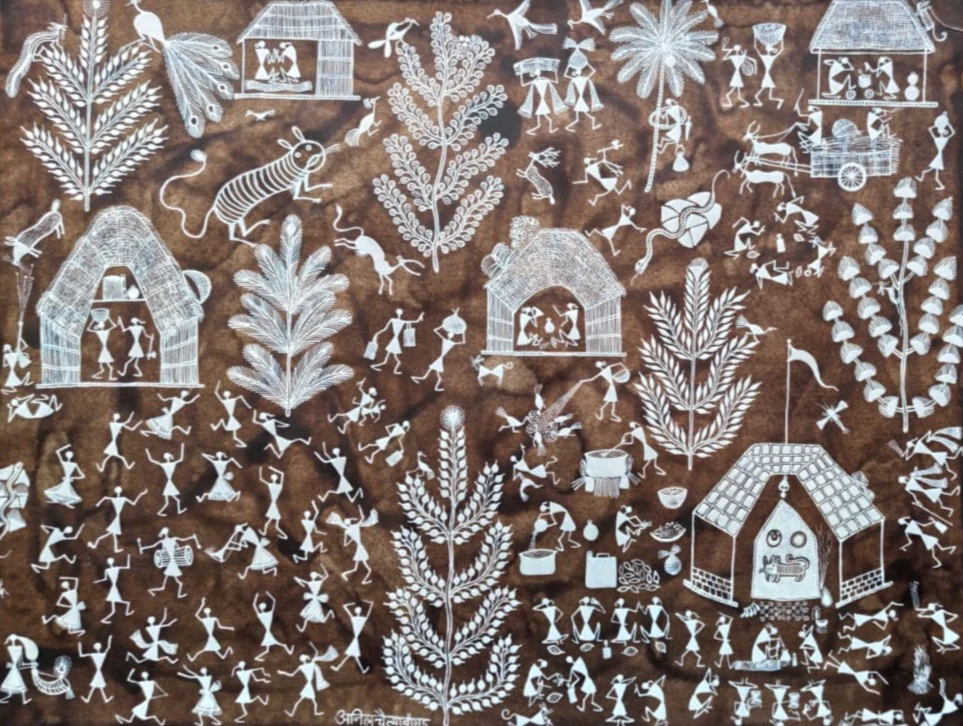
Anil Wangad is a distinguished contemporary Warli artist from Maharashtra, celebrated for carrying forward the traditional tribal art of the Warli community while introducing modern thematic narratives. Trained within his family lineage, he works with traditional materials such as rice paste, cow dung and natural pigments. His artworks often portray village life, deities, farming practices and ecological harmony, marked by minimal compositions, symbolic motifs and a strong balance between tradition and contemporary expression.
Dilip Bahotha
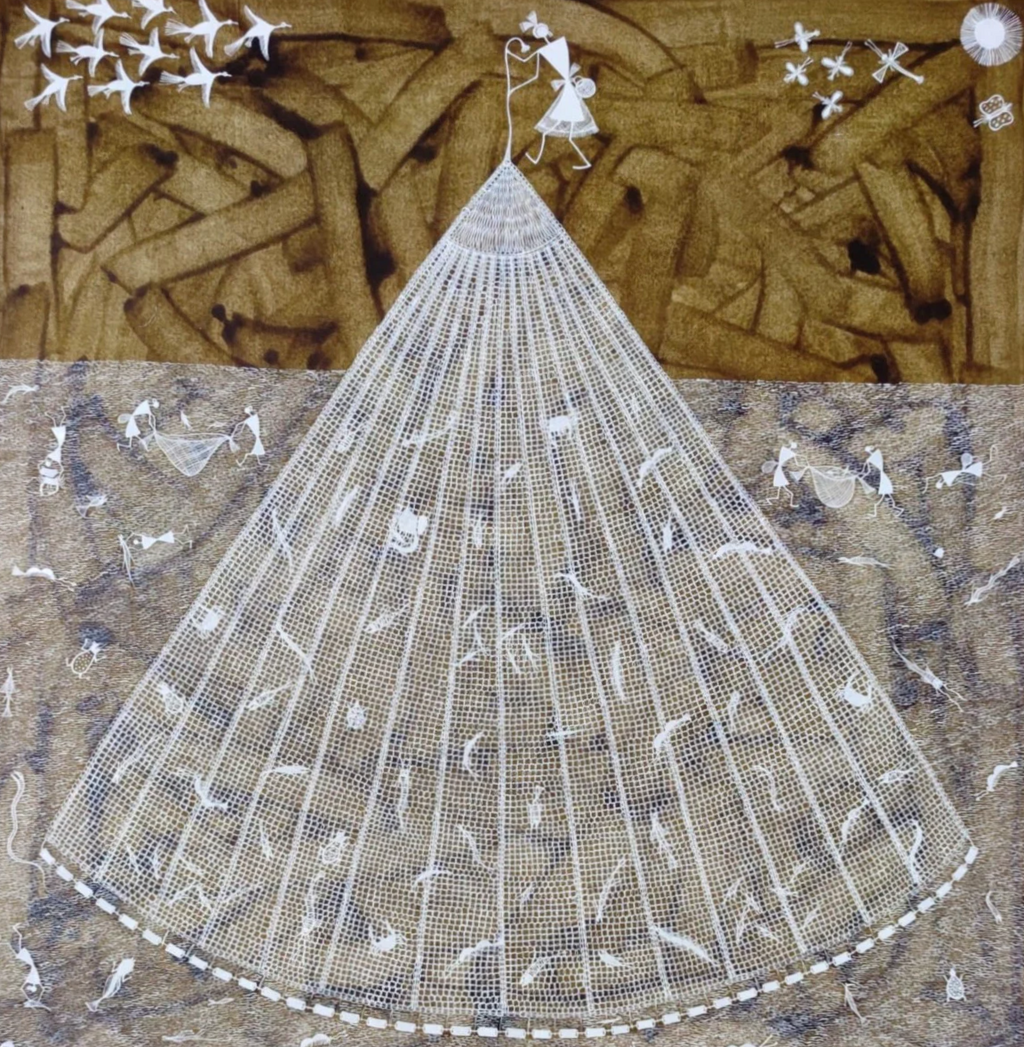
Dilip Bahotha is a Warli artist from Varkhande village near Talasari, Maharashtra, known for his innovative and deeply narrative interpretations of Warli tradition. A self-taught artist with over seventeen years of experience, his works frequently focus on rural life, forests, water bodies and the interconnectedness of humans and nature. His compositions are recognised for their originality, ecological themes and intricate detailing, while remaining rooted in the ritualistic and symbolic vocabulary of Warli painting.
Sayli Prasad Dadoda
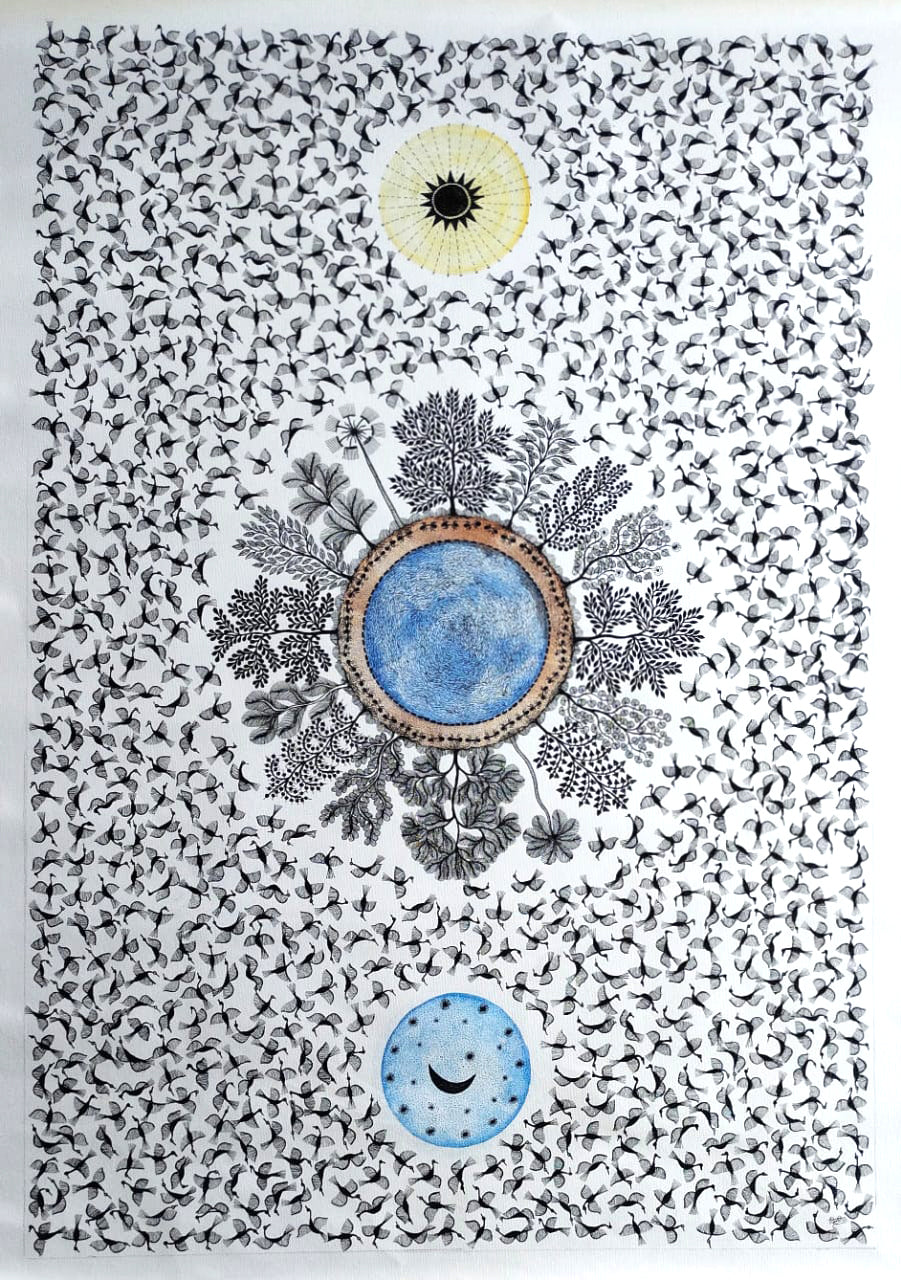
Sayli Prasad Dadoda is a contemporary Warli artist from Maharashtra whose work is deeply inspired by the natural world and the environmental ethos of the Warli tradition. Her paintings often centre around forests, wildlife, the Tree of Life and ecological cycles, presenting highly detailed monochromatic compositions enriched with fine linework and stippling. Through her art, she captures the harmony between flora, fauna and the spiritual worldview of the Warli community.
Warli Paintings for Home Decor
Warli paintings have become a distinctive choice for home decor because of their minimalist beauty, earthy aesthetics and deep cultural significance. Characterised by monochromatic palettes, geometric human figures and symbolic depictions of daily life, Warli art adds a rustic yet sophisticated charm to both traditional and modern interiors.
Framed Warli paintings are often used as statement pieces in living rooms, hallways, study spaces and bedrooms. Scenes of village life, harvest celebrations, dances, wildlife and the iconic Tree of Life create visually engaging focal points while bringing a sense of simplicity and connection to nature into the space.
Warli designs are also widely incorporated into home furnishings such as wall hangings, cushion covers, bedspreads, table runners, lampshades, decorative panels, gallery walls. Their organic patterns and neutral tones make them versatile for a wide range of interior styles. Warli motifs are also commonly used in meditation spaces like pooja rooms and creative corners for their grounding and harmonious visual appeal.
Warli Paintings for Gifting
Warli paintings make thoughtful and unique gifts for weddings, anniversaries, housewarmings, festive occasions and cultural celebrations. Valued for their simplicity, symbolic richness and handmade craftsmanship, these artworks represent India’s tribal heritage and timeless artistic traditions.
Handmade Warli paintings featuring themes such as community dances, marriage rituals, farming scenes, forests, animals and the Tree of Life are especially appreciated as gifts for their cultural symbolism and storytelling essence. Each piece reflects the close relationship between human life and nature, making it both meaningful and visually appealing.
Whether presented as framed artworks, decorative wall hangings or handcrafted utility pieces, Warli creations offer a beautiful blend of tradition, artistry and authenticity. Their eco-friendly materials, sustainable practices and enduring aesthetic appeal make them memorable gifts that celebrate India’s indigenous cultural legacy while adding warmth and character to any home.
FAQs About Warli Paintings
What makes Warli painting unique compared to other Indian folk arts?
Warli painting is distinctive because of its minimalistic visual language, where human and animal figures are created using simple triangles, circles and lines. Unlike many Indian folk arts, Warli traditionally uses only white pigment made from rice paste on a red ochre mud background. Its strong focus on nature, community life and ritual symbolism also sets it apart.
What materials are traditionally used in Warli painting?
Traditional Warli paintings are created using natural and locally sourced materials. The white pigment is made from rice paste mixed with water and tree gum, while the background is prepared using red clay and cow dung. Brushes are handmade from bamboo twigs, making the entire process eco-friendly and deeply rooted in sustainable practices.
What are the common themes and motifs found in Warli paintings?
Warli paintings often depict scenes from village life such as farming, hunting, fishing, dancing and marriage rituals. Common motifs include the Tarpa dance, the Tree of Life, animals, forests and sacred enclosures like the Lagna Chauk. These motifs reflect the Warli worldview of harmony between humans, nature and spirituality.
Does Warli painting have a GI tag?
Yes, Warli painting has been granted a Geographical Indication (GI) tag, which helps protect its authenticity and cultural heritage. The GI tag ensures that the art remains associated with its traditional geographical origin in Maharashtra and prevents misuse or imitation. It also supports tribal artisans by giving recognition to their indigenous craftsmanship.
What is the role of Warli painting in the ODOP (One District One Product) initiative?
Under the Government of India's One District One Product (ODOP) initiative, Warli painting acts as a flagship tribal handicraft representing Navsari (Gujarat) and the broader cultural landscape of Maharashtra. Its primary role is to revive ancient indigenous skills and transform traditional tribal art into a commercially sustainable global brand.
How has Warli painting evolved in modern times?
Originally practiced only during rituals and weddings by married women, Warli painting has now expanded into canvas, textiles, fashion and interior decor. Modern artists also use it to address themes like urbanisation, environmental awareness and social issues. Despite these changes, the core style and symbolism remain intact.
Why is Warli painting important in Indian cultural heritage?
Warli painting is an important part of India’s tribal and folk heritage because it preserves the history, customs and beliefs of the Warli people. It serves as a visual record of indigenous life and highlights ecological consciousness and community values. Its survival and global recognition make it a vital symbol of India’s diverse artistic traditions.
Where can I buy authentic Warli paintings online?
Collectors and art enthusiasts looking to buy authentic Warli paintings online can explore MeMeraki’s curated collection of traditional and contemporary tribal artworks created by skilled Warli artists and artisans from Maharashtra. From classic Tarpa dance compositions and Tree of Life motifs to depictions of village life, forests and ceremonial rituals, MeMeraki offers authentic handcrafted Warli paintings that celebrate the simplicity, symbolism and cultural richness of this ancient tribal art form. Each piece reflects the community’s deep connection with nature, sustainable practices and timeless storytelling traditions, making them meaningful additions to homes, collections and gifting.
Show Less